New 2011 Dodge Charger Unveiled

Monday, October 4, 2010 | 0 comments


Chrysler has officially unveiled the redesigned 2011 Dodge Charger, which comes with various improvements over the previous version.

With inspiration from the 1968-1970 muscle car, the rear styling mimics the old model’s full-width tail lamps. This large rear cluster is lit up with 164 LEDs to leave followers in no doubt when it comes to braking.

Under a new aluminum hood, engine choices are a 3.6-liter Pentastar V6, or 5.7-liter Hemi V8 engine in R/T trim. which delivers 290 horsepower and 260 pound-feet of torque. All-wheel drive will also be available in the R/T that comes with 19-inch wheels and, unique for a car, an active transfer case that can disconnect the front-axle to improve fuel economy.

Interior changes include a new design for the steering wheel, which gets a thicker grip. Chrysler says the Charger's interior has been tuned for better sound quality.

Source: Dodge


2011 Dodge Charger 2011 Dodge Charger 2011 Dodge Charger 2011 Dodge Charger 2011 Dodge Charger 2011 Dodge Charger 2011 Dodge Charger 2011 Dodge Charger


Press Release

Dodge Brand Product Onslaught Continues: Introducing The All-new 2011 Dodge Charger


World-class Performance And Precision With An Iconic Soul

October 5, 2010 , Auburn Hills, Mich. - With its iconic character, contemporary fastback four-door coupe proportions, world-class performance, craftsmanship and refinement, and state-of-the-art connectivity features, the all-new 2011 Charger is the Dodge brand's flagship that proudly delivers premium, world-class E-segment sedan precision at an incredible value.

The efficient and aerodynamic exterior of the 2011 Dodge Charger is spiritually inspired by the iconic second-generation Charger from the late 1960s, featuring a design that is sure to strike an emotional chord with Dodge performance enthusiasts of all generations.

With its sinister "ready to attack the road" face, the all-new Dodge Charger puts the world's best E-segment sedan competitors between its new "split crosshair" signature grille. Its sculpted all-new body is a conscious nod to its deep heritage and muscle-car roots. The Charger's profile is also a modern affair, a result of countless hours in the wind tunnel, from its lower hood line, faster windshield and radically raked back headlights to its tighter wheel openings, lower sill and race-car-like flat underbody, the Charger effortlessly cuts thought the air with its attitude intact. The aluminum hood features dual "scallops" that bring a sculptured, performance look to the front end, while large body-side scallops deliver a striking undulating A-line across the doors. Running front to rear is the iconic horizontal "coke bottle" or "double-diamond" body-side styling that creates a tapering silhouette accented with muscular front and rear fenders and gives the Dodge Charger one of the most distinct profiles on the road. Defining the fastback's wide stance is an all-new signature taillamp design that incorporates 164 illuminating LEDs to form its signature "racetrack" graphic and gives the new Charger its unmistakable character from blocks away.

The 2011 Dodge Charger's interior cockpit is meant to be an enthusiast office. The all new design feature premium materials throughout. Transmitting the performance chassis' world-class feel of the road, the all-new Charger features a new thick-rimmed three-spoke Dodge steering wheel for enhanced performance feel and grip. Crafted in world-class materials, Charger's passengers are surrounded with comfort, craftsmanship and style, thanks to premium soft-touch materials and four available distinct interior color combinations. The all-new 2011 Dodge Charger's state-of-the-art Uconnect® Touch integrates world-class infotainment and convenience technologies to keep passengers connected, comfortable and secure. From segment-leading Garmin® navigation, to dual-zone climate controls and the ability to check fuel prices with the integration of available SIRIUS Travel Link, Uconnect Touch delivers an excellent experience for Charger's driver and passengers.

Maximizing its unibody's world-class structural stiffness, Dodge Charger engineers were able to tune the cabin for sound quality (rather than sound level) by isolating powertrain, road and wind noise. In addition, Charger's unibody packages material and structural design improvements, including dual-pane acoustic windshield and front-door side glass, body-cavity silencing foam, under-flush roll-framed doors with triple seals and acoustic wheel-well liners to absorb road noise and quiet the cabin. Combined, these design improvements place the all-new Dodge Charger's interior sound quality among the best in the E-segment.

As the Dodge brand's flagship, the chassis of the all-new 2011 Charger is designed, engineered and fine-tuned to deliver a level of quality, capability and refinement that rivals the very best European, Asian and North American E-segment sedans. With its new second-generation E-segment rear-wheel drive (RWD) architecture, Dodge Charger features world-class suspension-tunings with re-designed geometry making for a nimble, balanced chassis that will build the Charger's legend as one of the best driving sedans in the world.

Engineered to perform against the best E-segment sport sedans, the all-new 2011 Dodge Charger SE and Charger Rallye feature the new 3.6-liter Pentastar engine for world-class levels of power, refinement, technology and fuel efficiency. For maximum thrills, efficiency and best-in-class power, the new Dodge Charger R/T lineup features the legendary 5.7-liter HEMITM V-8 engine with four-cylinder mode FuelSaver Technology.

The all-new 2011 Dodge Charger R/T with all-wheel-drive (AWD) features a re-thought stance and 19-inch wheels to make it much more appealing than ever before. The AWD preserves the Charger's character and deepens its performance envelope in the most treacherous conditions. The Charger AWD features a segment-exclusive active transfer case and front-axle disconnect system to improve fuel economy by up to 5 percent. No other major automotive manufacturer offers the combination of these two independent technologies. Dodge Charger's innovative AWD system seamlessly transitions between RWD and AWD with no driver intervention. When all-wheel drive is not required, the system automatically disconnects the front axle to maximize fuel economy while still providing the outstanding performance and handling inherent in rear-wheel drive vehicles.

The all-new 2011 Dodge Charger features more than 65 safety and security features, including standard Keyless Enter-N-Go and Electronic Stability Control (ESC) with segment-exclusive Ready-alert Braking and Rainy Day Brake Support safety features to improve overall vehicle handling and performance both on and off the track. Safety and security features available for the first time on the Dodge Charger include adaptive-cruise control (ACC) with forward-collision warning (FCW), blind-spot monitoring (BSM) with rear cross path (RCP) detection and ParkViewTM rear back-up camera with grid lines, all designed to provide the driver with added confidence while behind the wheel.

Built at the Brampton Assembly Plant in Brampton, Ont. (Canada), the 2011 Dodge Charger arrives in showrooms in the fourth quarter of 2010.

2011 Hyundai Sonata 2.0T Price

| 0 comments


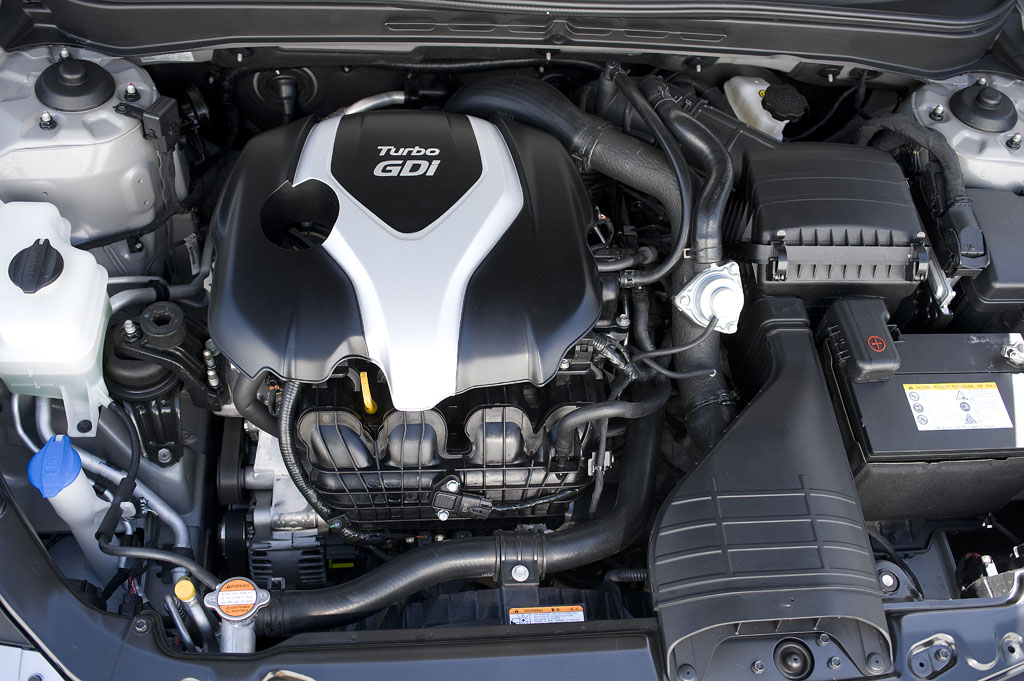
Hyundai Motor America has announced pricing for its all-new Sonata 2.0T Turbo. The Hyundai Sonata 2.0T turbo is powered by a 2.0-liter turbocharged gasoline direct-injection engine that outputs 274 hp and 269 lb-ft of torque from 1,750 rpm to 4,500 rpm. The company says the Hyundai Sonata 2.0T turbo has a twin-scroll turbo system design that's able to minimize the annoying effects of the turbo lag.

The 2.0T engine will be available on the SE and Limited trim level, with the 2.0T SE adding an upgraded fully automatic temperature control system, and the Limited adding the SE’s 18-inch hyper silver alloy wheels, dual exhaust, and steering wheel-mounted paddle shifters.

Pricing starts at at $24,145 MSRP for the Sonata SE 2.0T and $27,045 for the Sonata Limited 2.0T.


2011 Hyundai Sonata 2.0T 2011 Hyundai Sonata 2.0T 2011 Hyundai Sonata 2.0T2011 Hyundai Sonata 2.0T 2011 Hyundai Sonata 2.0T2011 Hyundai Sonata 2.0T 2011 Hyundai Sonata 2.0T 2011 Hyundai Sonata 2.0T 2011 Hyundai Sonata 2.0T 2011 Hyundai Sonata 2.0T 2011 Hyundai Sonata 2.0T 2011 Hyundai Sonata 2.0T2011 Hyundai Sonata 2.0T 2011 Hyundai Sonata 2.0T2011 Hyundai Sonata 2.0T


Press Release

  • The Sonata 2.0T debuts with Hyundai’s first four-cylinder turbocharged gasoline direct-injection engine
  • With a remarkable 33 mpg highway fuel economy rating, the 2.0-liter turbocharged gasoline direct-injection engine also delivers best-in-class 274 horsepower and 269 lb-ft of torque across a broad rpm range (1,750 rpm to 4,500 rpm), giving the Sonata 2.0T four-cylinder more power than all competitive mid-size V6 engines, all while using regular fuel
  • The 2.0T is a key part of Hyundai’s industry-leading Blue Drive fuel efficiency strategy
  • The twin-scroll turbo system design minimizes turbocharger lag while maximizing combustion efficiency and power output
  • The Sonata 2.0T is the second element of the game-changing 2011 Sonata product lineup, with the Sonata Hybrid, powered by Hyundai’s all-new Hybrid Blue Drive system, featuring breakthrough lithium-polymer batteries, to debut later this year

FOUNTAIN VALLEY, Calif., Oct. 4 — Hyundai Motor America has announced pricing for its all-new Sonata 2.0T Turbo, starting at $24,145 MSRP for the Sonata SE 2.0T and $27,045 for the Sonata Limited 2.0T.
With the addition of the all-new 2.0-liter Theta II turbocharged GDI engine, the new 2011 Sonata offers an unprecedented combination of segment-leading fuel efficiency and power, with 33 mpg highway and 274 horsepower. Remarkably, the Sonata 2.0T delivers these industry-leading benchmarks on regular fuel. Turbocharging and GDI are key elements of Blue Drive, the company’s environmental initiative to lead the industry in fuel efficiency.

The 2.0-liter turbocharged GDI four-cylinder engine produces 274 horsepower at 6,000 rpm and 269 lb-ft of torque from 1750-4500 rpm with regular fuel, while delivering 22 mpg city and 33 mpg highway. Hyundai’s 2.0T engine features a twin-scroll turbocharger that, when combined with the GDI system, results in crisp, responsive power delivery. Twin-scroll turbochargers have traditionally been used on more expensive high performance engines, but as with direct injection, Hyundai has chosen once again to apply this efficient technology in high volume to its most popular model.

The 2.0T engine will be available on the SE and Limited trim level, with the 2.0T SE adding an upgraded fully automatic temperature control system, and the Limited adding the SE’s 18-inch hyper silver alloy wheels, dual exhaust, and steering wheel-mounted paddle shifters. MSRPs excludes destination charge of $720.

Sonata SE 2.0T

2.0L Turbo GDI 4-cylinder engine
6-speed automatic with steering wheel mounted paddle shifters
18-inch Hyper Silver alloy wheels with performance tires
Sport-tuned suspension and steering
Dark chrome front grille
Chrome exterior door handles
Proximity entry with push button start
SE leather bolster/cloth insert sport seats
Leather-wrapped steering wheel and shift knob
Front fog lights / dual exhaust
Dual automatic temperature control
ESC/TCS/ABS/TPMS
Front active head restraints
Front, front seat side and curtain airbags
Chrome window belt-line moldings
Tilt and telescopic steering wheel with cruise, audio and phone controls
Metalgrain interior accents
AM/FM/XM/CD/MP3 with iPod/USB and Aux input jacks
Remote keyless entry and alarm
Immobilizer
Power windows, locks, heated mirrors
Advanced trip computer with custom settings
Active ECO System
Integrated Bluetooth with phonebook transfer
Daytime Running Lights (DRL)
Solar control glass

Navigation and Sunroof Package

Power tilt and slide sunroof
Navigation system with high-resolution touch-screen display
Dimension premium speakers, subwoofer/external amplifier

Sonata Limited 2.0T

Replaces/Adds/Deletes SE 2.0T equipment:

Power tilt and slide sunroof
Side mirror turn signal indicators
Leather seating surfaces
Heated front seats with heated rear seat bottom cushions
Floor console mounted rear vents
Premium door sill plates / “Limited” badge
In-dash 6-disc CD-changer
HD Radio technology with multicasting
Dimension premium speakers, subwoofer/external amplifier
Unique interior accents (Piano Black or Woodgrain)
Auto-dimming mirror/HomeLink/compass
Deletes sport-tuned suspension and steering

Navigation Package

Navigation system with high-resolution touch-screen display
Rear backup camera
Infinity premium speakers, subwoofer/external amplifier
Deletes 6-disc CD-changer and HD Radio Technology

2011 RSC Raptor GT

Sunday, October 3, 2010 | 0 comments


Manufactured in Germany, RSC’s newest supercar sports a front-mid-engine design and is rear-wheel drive. The RSC Raptor GT is powered by a 2.6-liter rotary engine that's available in four versions, with power outputs ranging from 500 hp, to 1,200 hp. The RSC Raptor GT S is the base model, equipped with Dry Sump, it develops 500 hp. The RSC Raptor GT RS has a water-to-air turbocharger system and develops 800 hp and the RSR has a twin-turbo and outputs a massive 1,200 hp.

The Raptor GT will be sold with different spec-variants called the GT S, RS, RSR and N-spec. Depending on which model, engine configurations vary and include a water-to-air inter-cooled turbo or a bi-turbo system. The engine is coupled to an 8-speed RSC R-Shift transmission with a hydraulic shift mechanism which makes gear changes in 25 to 35 milliseconds.

Inside, the RSC Raptor GT is also said to feature a pair of seven-inch digital displays coupled with a five-inch tachometer, gear indicator and shift lights, the entire package supposedly weighing in at a claimed 2,425 pounds. RSC also plans an all-wheel drive, mid-engine project with similar specs, which seems like a lot to bite off while they still appear to be chewing on this one.

Depending on the model, the body is of 80% glass fiber or carbon fiber and differs in details in the form and aerodynamics. The interior will get two 7" full-graphic-Diyplays, high-quality materials like carbon fiber, brushed aluminum and various types of leather.


RSC Raptor GT RSC Raptor GT RSC Raptor GT


Press Release

Rotary Super Cars Germany is a young company with the goal of offering symbiosis of high performance vehicles and active environment to create new benchmarks in the areas, power efficiency, value for money or the use of high-tech materials.

Since there is no vehicle that meets all these requirements, the construction of the RSC Raptor GT™ started in 2009. Systems such as the VAS (variable aerodynamic system) were developed and brought to small series production. This vehicle meets all requirements or exceed them. With enthusiasm and passion of our team involved in the development and production of the Raptor GT™. We guarantee the best workmanship and highest individuality. The selective use of proven components increases the active/passive safety while reducing production costs, which ultimately benefits every buyer.

With the Raptor GT™, we give our customers the opportunity to experience the unique combination of high end components and environmental protection on the roads and racetracks of the world. The Raptor GT™ doesn't follow the standard in many areas, he goes a very unique way with his drive and approach design. Each vehicle is handmade and unique, which corresponds exactly to the needs and wishes of the owner.

Drivetrain:
The RSC Raptor ™ GT S, RS, RSR and N-Spec does not have a conventional drive system as used in most of today's super sports cars. He has a self-developed and heavily modified, based on parts of the Mazda 13B MSP, high-performance engine with four rotors (4-Rotor rotary engine) and, depending on the model, a water-to-air intercooled turbo or biturbo system. This engine is the heart of the RSC Raptor GT™ and gives him his very special temperament. The power output of a rotary engine uniformly grows with increasing rpm. The high-performance engine in the RSC Raptor GT™ has the redline set depending on the selected driving mode, up to 7,500 rpm or 9000 rpm. The fuel E85 is used, which is produced from rapeseed. By using this fuel to reduce the emissions by about 90% is feasible.

The sequential 8-speed RSC R-SHIFT transmission in the RSC Raptor GT™ is controlled by a hydraulic shift system with shift times of 25-35 milliseconds. Furthermore, each RSC Raptor GT™ has a carbon-aluminum drive shaft, and an electronically controlled rear axle differential.

The powertrain is controlled by an engine management system, specifically developed from Bosch Engineering GmbH for the RSC Raptor GT™, including a complete electronic system consisting of ESP, ABS, EBD, VAS, R-TRAC (traction control), R-DIFF (electronic differential) and a Launch Control. The RSC Raptor GT™ RSR and N-Spec also has an active suspension. All electronic systems can be easily operated via the buttons on the steering wheel.

Body/Chassis:
Depending on the model the body of the RSC Raptor GT™ is of 80% glass fiber or carbon fiber and differs in details in the form and aerodynamics. Furthermore a wide range of special equipment is available. Starting with the rims, complete body equipment packages up to the painting - the customer has no limits.

The RSC Raptor GT™ also has the RSC VAS™ (Variable Aerodynamic System), a system that changes the aerodynamics and the aerodynamic properties of the RSC Raptor GT™ to generate more downforce at high speeds. This system include SBS (Speed Brake System).

Interior:
The RSC Raptor GT™ has two 7" full-graphic-Diyplays, where various telemetry data such as speed, mileage, temperatures, pressures, and the chosen vehicle settings and many other data, are available. These displays create exciting visual effects that show the high-tech genes of the RSC Raptor GT™. They are placed on the left and right of the large 5" tachometer with digital gear indicator and shift light. The driver is always looking at the relevant information and driving a RSC Raptor GT™ becomes a special experience.

The cockpit offers an unique combination of high-quality materials like carbon fiber, brushed aluminum and various types of leather. Many interior equipment packages are available. There also no limits for the customer.

Production levels of the RSC Raptor GT range from the base 500 hp 2.6L 4 rotor rotary to 800 hp turbo and 1.200 hp twin turbo variants. The cars are built in Germany. They are available in left- and right-hand drive configuration.

VelociRaptor:
The second car which is currently in the construction phase. The main facts: Mid-engine, AWD, 8-speed sequential RSC R-SHIFT transmission, RSC VAS, 90% carbon fiber, over 1.200 hp and a weight under 1.100 kg.
This car will set new benchmarks...

Rotary Super Cars Germany
(+49)1511 75 500 98

MTM Audi TT-RS

| 0 comments


German tuner MTM has taken their power packed MTM Audi TT RS to the Nardo circuit in Italy, as they wanted to see how fast it can go.

The MTM Audi TT RS is powered by the standard 2.5-liter TFSI engine that now has been upgraded to output 472 bhp (347 kW) at 7.000 rpm and an untold amount of torque.

This 472 bhp MTM Audi TT RS can rocket from 0 to 100 Km/h in 3.9 seconds, and as we've already mention its top speed is 312 Km/h achieved at Nardon while using 20 inch bimoto wheels wrapped in Dunlop Sport Maxx tyres.

The price for the engine upgrade is 14.500€. If you will also opt for the 20-inch bimoto forged rims and the 15-inch brakes with eight-piston calipers you will have to pay an extra 9.973 €. Tuner’s next stop? A TT-rS that will develop 500 HP!


MTM Audi TT RS MTM Audi TT RS MTM Audi TT RS MTM Audi TT RS MTM Audi TT RS MTM Audi TT RS MTM Audi TT RS


Press Release

MTM TT RS: With 472 bhp faster than 310 km/h


  • Audi refiner MTM drives 312 km/h with the TTRS in Nardo
  • Sophisticated technique to ensure best driving values
  • Complete package including wheels and brakes

How much engine performance do you need to break 300 km/h? The ones who think that this needs more than 500 bhp will learn that this is not correct. The TTRS with 472 bhp by MTM from Wettstetten / Ingolstadt was GPS measured to be 312 km/h at test runs on the Nardo highspeed track in Italy at the beginning of September 2010. For many other tuners a hard nut to crack despite of increased efficiency.

"It's not decisive what we measure on the dynamometer but how many bhp you get on the road" says Roland Mayer, owner and Head of the technical Department of MTM. The right master plan has a bigger effect on driving dynamics, acceleration times and maximum speed than the search for a maximum in performance values.

In the case of the MTM TTRS this means: modification of the control unit, MTM turbo charger and a complete new MTM exhaust system from turbo.

The result: 472 bhp (347 kW) with 7.000 rpm/min, a 0-100 km/h time of just 3.9 seconds and a top speed of 312 km/h - driven in Nardo with Dunlop Sport Maxx tyres on 20-inch bimoto wheels.

The MTM TTRS with 472 bhp doesn't has to fear the competition of other tuners, who are still fighting with 300 km/h and can't reduce 0-100 km/h time under 4.0 seconds despite a plus of 30 bhp.

MTM is one of the leading and at the same time the fastest of all Audi refiners worldwide. Within the last years engineers from Wettstetten showed best values:

MTM RS6 R with a top speed of 344,2 km/h is the fastest station wagon in the world. A MTM customer drove this record in Nardo in 2009. Moreover the fastest Bentley GPS measured 331 km/h in 2008 is from Roland Mayers workshop.

The TT Bimoto with two engines set as well a new record by driving 393,6 km/h in Papenburg in 2007. Today the Bimoto is still holding the track record for street-legal cars in Nardo driven by Florian Gruber. Nardo test drives under extreme conditions are an important part of MTM development work. Outside temperature was temporary at 35 degrees.

The costs for the upgrade from 380 to 472 bhp are about 14.500 € incl. tax and installation. The price for 20-inch bimoto forged rims, 15-inch brakes with eight-piston calipers (front axle) is 9.973 € incl. tax and installation.

Right now MTM is working on an over 500 bhp version.

2010 Paris Auto Show: Peugeot HR1 Concept

| 0 comments


Peugeot has unveiled new HR1 urban concept car which will debut at the 2010 Paris Auto Show opens on 2 Oct 2010. It's a small crossover, mixing the best bits of coupe, city runaround and SUV. Sound familiar? Yep, it's sort of like a shrunken Range Rover Evoque.

The car isn't as attractive as the EX1 -- it's tall, chunky and ever so slightly odd-looking. But it does have some interesting tech additions. The most notable of these is an Archos 9 PC Tablet mounted in a tray on the passenger side of the vehicle.

The three-cylinder 1.2-liter gasoline engine is a version of Peugeot's future family of efficient three-cylinder engines that is now in development, the automaker says. It's teamed with a rear-positioned electric motor with all-wheel drive and a combined 147 horsepower. The 19-inch wheels are fitted with Michelin tires.

The car’s instrumentation suggests total command of the vehicle by the driver, with ergonomically placed controls, a small steering wheel, and a Head-Up display allowing information to be seen without the driver taking their eyes off the road.
The ingenuity of the HR1 resides also in its modularity. Its load area is practical and accommodating thanks to its flat floor and sides, offers a load space of 25.9 sq ft.

Total output for the hybrid powertrain on the Peugeot HR1 is 147 bhp, and power is sent to the wheels through an electronically-controlled 6-speed manual gearbox. The driver can also choose between two modes of operation, sequential or automatic. In a combined cycle the Peugeot HR1 can return 81 mpg (2.90 l/100km), while CO2 emissions are of 80 g/km.


Peugeot HR1 Peugeot HR1 Peugeot HR1 Peugeot HR1 Peugeot HR1 Peugeot HR1 Peugeot HR1 Peugeot HR1 Peugeot HR1 Peugeot HR1 Peugeot HR1 Peugeot HR1 Peugeot HR1 Peugeot HR1 Peugeot HR1 Peugeot HR1 Peugeot HR1 Peugeot HR1 Peugeot HR1 Peugeot HR1


Press Release

PEUGEOT HR1 – TOTALLY URBAN AND CONNECTED

29/09/10
  • New three-cylinder THP 110 petrol engine
  • 81 mpg and just 80 g/km
  • Uses Peugeot's HYbrid4 technology
  • Innovative rear "stowaway seat" system
  • Clever "hands-free" onboard system control
  • Provides enjoyable urban motoring and genuine environmental efficiency

The HR1 is an exclusive and innovative urban concept car that blends together a number of genres (city run-around, coupé and SUV). It is targeted at active young city dwellers smitten with design and innovation who are in search of a vehicle that matches their profile.

Peugeot is always exploring new motoring ideas and this inventiveness has already given rise to many production vehicles and concept cars, including a number of genuine commercial and design successes (Coupé/Cabriolet, the 3008... and more recently the BB1 concept vehicle).

The HR1 is based on several different body designs: city run-around, coupé, SUV... and, in doing so, is creating its own identity and new and original benefits.

The HR1 has been created to appeal to young city dwellers; individuals and couples, who lead an active outgoing life and who seek out new lifestyle experiences in relation to their leisure activities and their mobility.

It is designed to make urban travel easy and pleasurable even in the busiest or most confined urban areas. It is helped by its particularly compact dimensions (a length of 3.67 m and very short front and rear overhangs) but also an original system for getting into and out of the vehicle. Based on the Marque's experience in this field, the HR1 has two electric "scissor" doors to facilitate access under all circumstances (restricted parking, small garage, etc...). To improve visibility and manoeuvrability and provide a dominant driving position, the ride height of the vehicle has been raised, also improving ground clearance.

The HR1 contains all the genes of the Peugeot Marque, whose new stylistic design codes were first unveiled on the SR1 Concept car. The HR1 shares the same expressive headlamps with their finely chiselled design and the single "floating" front grille which seems to be detached from the rest of the body, as the SR1.

The overall styling is athletic, powerful and dynamic and is strengthened further by the flowing wheel arches, large wheels and the raised sections above the rear windscreen, reminiscent of the "double bubble" roof design of the RCZ Coupé. The finesse of the superstructure, the two-tone interplay of polished and chrome materials, every component expresses the high level of build quality, a sign of the meticulous attention paid to every detail. This is true also of the headlamps and "full LED" rear lights, finished in the style of hi-tech jewels which give the car a unique signature by day and by night.

Innovation is a strong feature of all Peugeot models and especially the HR1. At the rear, the roof bars serve as an ingenious hinge for the opening one-piece, dark tinted glass tailgate.

In keeping with the recent design trends of the Marque's latest vehicles, the interior of the HR1 has a structured design, with a "High-Tech Coupé" driving position, providing a special ambiance through the combination of style, quality of finish, equipment and ergonomics.

The driver and passenger are both provided with a "privileged area" within the vehicle, separated by a centre console which adds to the futuristic design and helps increase light levels due to the use of electroluminescent diodes. The fitment of the two glazed roof sections, dedicated to the right and left occupants, with an electro-chrome finish, also help to diffuse more light on request.

The car's instrumentation suggests total command of the vehicle by the driver, with ergonomically placed controls, a small steering wheel, and a "Head-Up" display allowing information to be seen without the driver taking their eyes off the road.

The passenger compartment of the HR1 has a very "authentic" feel, dynamic, technological and protective, able to shield its occupants from the stress of the outside world.

The HR1 is equipped with particularly innovative controls which operate what is known as the "man-machine interface". The concept car thus has a "movement recognition" system. Simple and intuitive, this allows the driver to scroll through functions and select available settings with a simple movement of the hand. For example, by rotating the hand the user can scroll menus, displayed in the manner of a carousel. The driver can also choose to switch control of the menus to the front passenger, with a sweep of the hand from left to right.

The technology controlled by this method includes the audio, satellite navigation and air conditioning systems. The driver can also select, at his discretion, the preferred type of information to be displayed in the instrument panel: rev counter, water and oil temperature during "dynamic driving", or tourist information when "cruising". The front passenger, meanwhile, benefits from a mobile PC tablet which allows data to be shared and exchanged with the driver's display.

The ingenuity of the HR1 resides also in its modularity. It has been designed primarily for young city dwellers without children, in search of a fun vehicle that is fashionable and roomy enough to carry their leisure equipment (bicycle, diving equipment, etc...) or be loaded up with shopping. Its load area, practical and accommodating thanks to its flat floor and sides, offers a load space of 734 litres.

The passenger compartment can be very quickly configured to accommodate either three or four full size seats, thanks to the clever "stowaway seat" system. With this system the rear seats fold down flat and then fit snugly behind the front seats creating a flat load area floor. As on the RCZ, the special shape of the rear tailgate glass with its raised "double bubble" sections, allows the rear headroom to be optimised. When both rear seats are raised, the boot capacity is reduced, but it still offers a substantial 180 litres of space.

One of Peugeot's key priorities is to retain its environmental leadership over the coming years. In this respect, the HR1 Concept, which is most at home in the city, needed to meet this brief by being particularly efficient and innovative.

The HR1, therefore, incorporates Peugeot's innovative HYbrid4 technology with all its associated benefits. With an internal combustion engine at the front and an electric motor at the rear it can be driven as often as possible in "zero emissions" mode in town at low speed, or with both "engines" together, providing four-wheel drive capability where challenging surfaces warrant it.

Under the bonnet, the internal combustion engine which drives the front wheels is a new three cylinder petrol unit. It has a capacity of 1.2 litres and, using Peugeot's THP technology, produces 110 bhp. It is one of the members of the future family of three cylinder engines currently under development. As part of Peugeot's downsizing strategy, the engine has been developed using the most advanced technologies, combining both a high level of performance with environmental efficiency.

It is linked to a 37 bhp electric motor and, therefore, has a maximum potential power output of 147 bhp, with a combined fuel consumption of 81 mpg and CO2 emissions of just 80 g/km.

The electronically-controlled 6-speed manual gearbox (with control paddles on the steering wheel and a centrally mounted gear lever) coupled with this power train is designed to offer maximum control. The driver can also opt between two modes of operation, sequential or automatic.

The HR1 has a pseudo McPherson front suspension and a torsion beam rear suspension. Steering is provided by an electric power steering system which offers excellent handling characteristics at low speed, astonishing agility during manoeuvres and maximum accuracy at higher speeds, for good all-round performance.

With its high-performance suspension, efficient steering and new power train, the HR1 provides a unique driving experience, combining the emotion of real driving enjoyment with the rigour of genuine environmental efficiency.

Technical Data – Peugeot HR1 Concept Car

Petrol Engine Capacity 1,197 cc
Maximum power 110 bhp
Maximum torque 195 Nm
Rear Electric Motor Type Synchronous with permanent magnets
Continuous / peak power 27 bhp / 37 bhp
Continuous / peak torque 100 Nm / 200 Nm
Total Maximum potential power 147 bhp
Tyres Type Michelin
Size 225 45 R19
Transmission Type Electronically-controlled six-speed manual gearbox
Fuel tank Capacity 41 litres
Fuel Consumption Combined cycle 81 mpg
CO2 (g/km) 80 g
ZEV Combined cycle 0
Zero Emission Vehicle CO2 (g/km) 0
Maximum range at constant speed 1.55 miles
Dimensions Overall length 3694 mm
Overall body width 1755 mm
Overall height – with full tanks 1492 mm
Wheelbase 2311 mm
Front / rear overhang 703 mm / 680 mm
Front / rear track 1534 mm / 1512 mm
Interior Load area volume in 2 seat configuration 734 litres
Load area volume in 3 seat configuration 457 litres
Load area volume in 4 seat configuration 180 litres
Weight Kerb weight with full tanks 1130 kg

 
© Copyright 2010-2011 Next Carscoop All Rights Reserved.
Template Design by Herdiansyah Hamzah | Published by Borneo Templates | Powered by Blogger.com.