Ferrari California Sports Car with new V8 Engine 8 cylinders to guarantee superb performance.

Friday, November 13, 2009 | 0 comments

Ferrari California

The Ferrari California is an exceptionally innovative car whose philosophy takes its inspiration from the spirit and emotions of one of the great Ferraris of the past, the 1957 250 California, a superbly elegant open top car designed for the track, which has, over the years, come to symbolise not only superior sportiness and performance but also exclusivity, craftsmanship and faultless sophistication.
Ferrari California is car with 8 cylinders has maximum output reached 460 Hp or equal 107 Hp/liter in 7,750 rpm. With a specific power of over 105 hp per liter, its maximum torque is 358 lb-ft at 5,000 rpm, 75% of which is available at just 2,250 rpm. The Ferrari California takes less than 4 seconds to accelerate from 0 - 60 mph and delivers a blistering 192 mph top speed. The new V8 features direct fuel injection and variable timing (on both intake and exhaust) to guarantee superb performance, exceptional handling, and fuel consumption and emissions that easily comply with the toughest Euro 5 and Lev2 standards Even can drive in high speed, the Ferrari California has an ideal balance.The California's mission is slightly different than other Ferraris; the all-new model is aimed more at a buyer who may not have considered Ferrari before, one who wants both high performance and high-end luxury.This new car joins Ferrari's 8-cylinderrange, so far consisting of the mid-engine models like the F430 only, as the first 8-cylinder Gran Turismo. .....................................Ferrari California
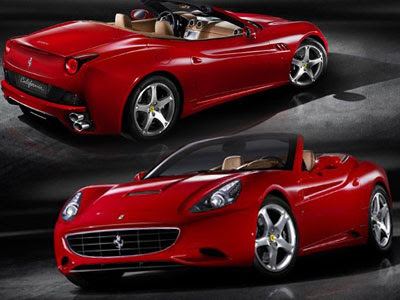
The Ferrari California is available exclusively as a convertible with retractable folding hard top in either a two-seater version with a traditional rear bench or in the 2+2 version which sees the rear bench equipped with seating for one to two passengers. In addition to its retractable hard, the California also offers a new direct injection V8 engine, a 7-speed dual clutch gearbox with steering wheel-mounted F1-style, an evolved F1-Trac traction control system, and standard Brembo brakes with CCM (carbon ceramic material) discs. This is the first V8 in the history of Ferrari road-cars to be mid-front mounted. Built entirely from aluminium, it retains the typical Ferrari architecture with a 90° angle between the two cylinder banks and a 180° angle between the cranks. The Ferrari California has length 4.563 mm, width 1.902 mm, height 1.308, wheelbase 2.670 mm, front track 1.630 mm, and rear track 1.605 mm.

The Russian Supercar Marussia B1 Powered by 3.5 litre V6 Engine.

Thursday, November 12, 2009 | 0 comments


Marussia B1 Russian supercar

Marussia B1 a Russian supercar 3.5 litre V6 Engine.
The Marussia B1 is a Russian made supercar developed entirely by a team of Russian designers and engineers.The B1's aerodynamic bodywork was developed courtesy of a competition which invited young Russian designers to submit their concepts to the company. The winning design would then be used to help shape the final product.The defining characteristics of the Marussia B1's exterior design are the aggressive, sharp lines and the two-tone paintwork. And despite the B1 being Marussia's first attempt at a sports car the end result is appealing from a styling point of view.
Marussia B1 Russian supercar

Unfortunately despite the supercar looks the Marussia B1's drive train is not up to supercar levels. Or even premium sports car numbers. Located in a mid-mounted position is a 3.5 litre V6 which produces 245 horsepower and 330 Nm of torque @ 3,600 rpm. Marussia claim this is good for a 5 second 0-60 time, and a 155 mph top speed. Thankfully however the company is working on developing different drivetrain options which should help the performance match the appearance. Marussia B1 Russian supercar

The interior of the Marussia B1, which was developed through a collaboration between Italian and Russian designers, features a pair of reclining deeply-bo
lstered sports seats and a squared off three-spoke sports steering wheel. The dash of the Marussia B1 features three separate LCD displays which provide information for both driving functions and the entertainment systems. The displays are touch screen, but the functions can also be controlled with the help of a joystick mounted on the centre console.The whole interior can be upholstered in a variety of different colors and finishes to suit the owners tastes.

Marussia B2 3.5-liter V6 Engine the Supercar Russian first displayed at the 2009 Frankfurt Motor Show

| 0 comments

Marussia B2 Supercar Russian

The B2 is the second supercar model to be produced by the Russian manufacturer Marussia. Following close on the heels of the Marussia B1 which was revealed only months earlier, the B2 is a dramatically styled supercar which was developed in-house by Marussia's design team based in Moscow. The car was first displayed at the 2009 Frankfurt Motor Show, but these are the first pictures of the car outside of the motorshow surroundings.According to the main ideologist of creation of the first Russian Nikolay Fomenko's super car, its company is capable to develop almost any body for short enough term. It is interesting that in Frankfurt Fomenko has shown at once three cars – besides B2 at the stand there were two more models with body В1. But the main nuance consists that cars are made of different materials: at white Marussia and at dark blue В2 bodies carbon.
Marussia B2 Supercar Russian

Befitting a mysterious Russian supercar the company is keeping pretty quiet about what lies underneath the bodywork - and even the materials used in the construction of the body is being kept a secret, but supposedly it's a special type of plastic. And while Marussia won't yet divulge the specifications or performance offered by the drivetrain, they did reveal that both the engine and gearbox are being developed in conjunction with the highly respected powertrain engineering firm Cosworth.. Marussia B2 Supercar Russian

Marussia are hoping to start delivering the first B2's to their new owners in 2010 and aim to be producing 150 units a year. And just like the B1, buyers of the Marussia B2 will have an extensive customization and options list. Initially the car will be offered for sale in most of continental Europe and the Near East. By the end of 2010 the company hope to begin exports to both the US and UK shores. A racing version is also in the pipeline for late 2010.
Marussia has teased their new vehicle, the Marussia B2, for a Frankfurt premiere. The B1 was designed "in the style of a jet fighter," and looks like it uses rivets as styling points. The darkened photos are intriguing, to say the least.The car looks rather interestingly, and body panels are adjusted to each other aloud better, than on the pre-series sample. The interior of the presented cars is finished by a skin, and internal furnish, probably still will lead up to mind. According to Nikolay Fomenko, welding of power structure of a body is in general its pride.
The Russian company introduced their B1 Hybrid Supercar in their home country last year. The €100,000 car uses a 3.5-liter V6, the B1 debuted with everything from a plasma video screen, to a high-speed internet connection. It was designed by Top Gear Russia star Nikolai Fomenko, a former driver in both the Le Mans and FIA GT series.Both cars will be on stage in Frankfurt from this week on, marking the non-Russian debut of the Marussia B1 and the global debut of the Marussia B2.Marussia B2 supercar

Mazda RX-Z Concept 3.0 litre V6 and two electric motors Sports Car Coupe.

Wednesday, November 11, 2009 | 0 comments

Mazda RX-Z Concept Sports Car Coupe

Mazda RX-Z Concept 3.0 litre V6 and two electric motors Sports Car Coupe.
The Mazda RX-Z concept is a proposal for a 2+2 sports coupe to replace the aging Mazda RX-8. The design was conceived by Andrus Ciprian, a design student from Romania whose previous work includes the Dacia MC concept. Like the MC the RX-Z concept was created using the 3d modeling program 3D Studio Max, and rendered with the help of Mental Ray. Mazda RX-Z Concept Sports Car Coupe

The RX-Z was developed as Ciprian puts it; "as a link between fossil fuel cars and more ecological ones." To achieve this the proposed drivetrain for the concept includes a 3.0 litre V6 diesel engine up front - which replaces the notoriously thirsty rotary engine from the RX-8. And a pair of electric motors at the rear. Under normal conditions the RX-Z would be driven solely by the diesel engine. But at low speeds around town the electric drive can be used on its own for emission free motoring. At higher speeds the electric motors work in conjunction with the V6 engine to provide a boost function. A start/stop technology which is integrated into the engine further increases fuel efficiency.
RX-Z concept is equipped with four doors. The rear doors are half-sized and hinged at the rear. This helps to disguise them into the bodywork and reduce their impact on the flowing lines of the car.Mazda RX-Z Concept Sports Car Coupe

One of the more unusual features of the Mazda RX-Z concept is the rear light panel. In the middle is a display screen which can light up with any text written by the driver. Presumably you can only 'write' on the back of your car when stopped, otherwise this would be one surefire way of either getting in a crash or getting in trouble!

Volkswagen L1 Concept Redefines Classic and Aesthetic vehicle traits.

| 0 comments


Volkswagen L1 Concept

In the world today the
Volkswagen L1 Concept is unique. Thanks to a carbon fibre reinforced plastic (CFRP) body, it weighs just 380 kilograms. The two-seater is powered by a new common rail turbo-diesel (two-cylinder TDI) and an electric motor. With its average fuel consumption of 1.49 litres diesel per 100 kilometres, this fully road-ready and extremely aerodynamic L1 (Cd 0.195!) is advancing to become the most fuel-efficient hybrid automobile in the world. CO2 emissions of the 160 km/h fast concept car are just 39 g/km. If the Volkswagen L1 were to also go into production in 2013, it would debut an entirely new lightweight car concept and introduce a new era in automotive production.
The TDI, E-motor and 7-speed DSG are located at the rear, and they combine to create the most fuel efficient road-legal car hybrid drive in the world. Proof of this are its 1.38 litre per 100 kilometres fuel consumption and 36 g/km CO2 emissions.Naturally, the Volkswagen L1 also has a Stop-Start system that automatically shuts down the engine when vehicle has stopped and restarts when the accelerator or E-pedal is pressed.
The TDI engine in the
Volkswagen L1 Concept is a new development. Yet, even here Volkswagen has been able to exploit synergies to design an engine that is both innovative and cost-effective.
Gear shifting work aboard the Volkswagen L1 is handled by the 7-speed DSG, which is one of the most innovative automatic transmissions in production.
The Volkswagen L1, equipped with ABS and ESP, has a top speed of up to 160 km/h - this is remarkable considering its fuel efficiency. With maximum acceleration from a standstill, the two-seater reaches 100 km/h after just 14.3 seconds. The fuel tank holds just ten litres yet, this is sufficient for a theoretical driving range of about 670 kilometres, given the car's 1.38 litre average fuel consumption.

Volkswagen L1 Concept

Talking about car driving as 'piloting' might sound out of place, but in the case of the
Volkswagen L1 it is wholly appropriate. The driver (in the CFRP tube frame seat) and passenger (in the fixed CFRP seat that is part of the monocoque) sit one behind the other.
To start the Volkswagen L1, the driver pushes a button on the right side of the steering wheel. When it is rotated, the round start button simultaneously serves as a gear selector switch and is used to activate the electronic handbrake (Drive, Neutral, Reverse and Park). The entry canopy and rear hatch are opened electrically by touch controls to the left and right of the driver. Also designed as touch sensors are controls for the entire air conditioning control system. Via multifunctional keys in the steering wheel, the driver controls the on-board computer, navigation and entertainment systems.
The classic door mirror and rear-view mirror have been completely eliminated on the Volkswagen L1. In their place, cameras display images on OLED-active (OLED = organic light emitting diode) displays located on the left and right sides of the instrument panel. A Park Distance Control (PDC) system makes parking easier as well.
Both technically and visually, the CFRP body is already a significant achievement in car design. Unique on this car: the proportions of its dimensions. While the length of the Volkswagen L1 at 3,813 millimetres is still similar to that of a Volkswagen Fox, and its height of 1,143 millimetres nearly matches that of a Lamborghini Murciélago, the car's aerodynamically optimised width (1,200 millimetres) has no comparisons in the world of today's production cars.
The two-seat monocoque, including the tubular frame driver's seat and passenger seat as well as the exterior body skin, all consist of CFRP. There are no doors. Instead, the driver and passenger climb into the Volkswagen L1 from the top.
The reason that CFRP is the ideal material for the Volkswagen L1 body is demonstrated by considering its weight and strength.
And there are other advantages: the material's extremely high stress limits and its ideal forming properties for even the most challenging of design features.
The design and styling of the Volkswagen L1 Concept - function and form - combine to form one uncompromising unit. Walter de Silva, Head of Design for the Volkswagen Group has this to say: "The design of the Volkswagen L1 redefines classic and aesthetic vehicle traits. Especially significant, of course, is how the nearly rocket-shaped lines catch one's attention. All of its moving parts are integrated so accurately that the body resembles a rocket or jet. It is a body that cuts through the air with minimal aerodynamic resistance.
"

BlueSport Volkswagen Concept clean diesel 2.0-liter TDI engine

Tuesday, November 10, 2009 | 0 comments


Volkswagen Concept BlueSport

Is the latest
The new Volkswagen Concept BlueSport addition from the German manufacturer which offers maximum driving fun with minimal fuel consumption! Why we say minimal fuel consumption? Because the new concept is powered by a clean diesel engine, with common rail injection and downstream NOx storage catalytic converter delivers dynamic performance, capable to deliver an impressive 180 hp (132 kW) (although it was not confirmed we are sure that this is a 2.0-liter TDI engine).
Volkswagen Concept BlueSport

The engine is connected to a
6-speed DSG dual clutch transmission which transfers the power to the rear wheels. The sprint from 0 to 100 km/h (62 mph) is made in just 6.6 seconds while the top speed is limited to 226 km/h (147 mph). Due to the fact that the vehicle integrates two technologies that are part of the so-called Eco mode, automatic start-stop system and energy regeneration ( both of them deliver an additional fuel savings of up to 0.2 liter per 100 kilometers in city driving ), the vehicle delivers an impressive fuel consumption of just 4.3 l/100 km or 54.7 mpg. As you can see from the photos the Concept BlueSport was unveiled in a Flex Silver finish with an orange fabric convertible top while at the interior we find an easy to operate touchscreen and veather upholstered seats in lightweight construction with their single-piece seatbacks.


© Copyright 2010-2011 Next Carscoop All Rights Reserved.
Template Design by Herdiansyah Hamzah | Published by Borneo Templates | Powered by Blogger.com.